• Home
  • About W3 Group Marketing
    • Testimonials
  • Contact Us
  • Marketing Blog
  • Marketing Services
    • Search Engine Optimization (SEO)
    • Video Marketing – YouTube Marketing and more
    • Website Design
    • Local Search
    • Social Media Marketing
    • Clickable Graphic Ads for Online Classifieds
    • Online PR
    • Market Research
    • Competitive Intelligence
    • Copy Writing
    • Article Marketing
  • Press

Video SEO Live Demonstration

Feb11
2013
Written by
Tweet

Yesterday, I spoke at Dr. Michael Craig’s Logical Soul Coach Training program about how to attract new clients for a coaching practice.  One of the main topics I was sharing was Video SEO and how to rank on Google by using a YouTube video.

Before I went on, I recorded a quick video with Parenting Coach Robyn Ladinsky and optimized the video, uploaded it to my YouTube channel, and optimized everything about the video that I could on YouTube.  After all, I love to over-deliver, and I thought this would be a great way to both give more than expected to one of the coaches in the training workshop as well as provide powerful proof of how effective good Video SEO can be.

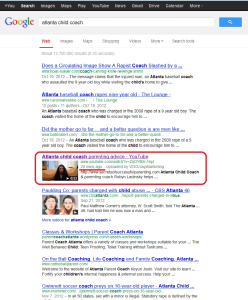
Page one of Google in 20 minutes for Atlanta child coach 248x300 Video SEO Live DemonstrationTwenty minutes later, the video was on Page One of Google for “Atlanta child coach” – just in time for me to go on stage and talk about how video in general, and YouTube video (and Video SEO) in particular can be a powerful way to help your business get found fast so that you can get in front of your target audience and, in turn, increase your prospects and help grow your sales.


Here’s the video we did:

Short, sweet, simple and to the point, right?  No fancy editing, no slick Hollywood-style video production, just Robyn talking about who she is, what she does, and who she helps.

So here’s a quick video testimonial that Robyn was kind enough to give me:

Then THIS video also got to page one of Google in less than an hour.

Video SEO Testimonial Google page one in 52 minutes 300x227 Video SEO Live Demonstration


There are a couple of key points here that can help you with marketing your business:

First, the obvious: video marketing and video SEO are extremely powerful ways to get you noticed, fast.

Second, this was a live demo I did for a speaking engagement for this workshop.  There was no pre-prep, no gimmicks, nothing of the sort.  It was transparent so the audience knew that, starting from scratch, I was able to get results extremely fast.  It was a powerful way to get that “wow” factor so that the audience immediately knew that I don’t just spew out a lot of hot air – I walk the walk.  How can you immediately connect with your audience so that they perceive you as someone credible and who can actually do what they say they can do?

Posted in Advertising, SEO, Social Proof, Uncategorized, Video Marketing - Tagged local SEO, marketing strategy, Off-Page SEO, Search Engine Optimization, Search Engine Results Page, SEO, video SEO, YouTube

Comical Comment Spam

Jan30
2013
Written by
Tweet

120px No spam.svg  Comical Comment SpamIf you’ve been blogging for more than a week, and have comments enabled on your blog, you’ve probably seen comment spam in action.

Comment spam is basically the same thing as email spam, but it’s found in blog comments instead of an email message.

Comment spam can be as few as one word, all the way up to several paragraphs.  It is usually rife with spelling and grammar errors, if it even makes sense at all.  These comment spammers’ typical goals are to get links back to their sites in the hopes of boosting their SEO value (and search engine rankings) so as to boost their websites’ sales.  More on this later.

Sometimes the goal is very different: to get people to visit a page that downloads some sort of malware (virus, spyware, etc.) to their computers and then all kinds of bad things can happen.

But this post is more about the misguided efforts of the spammers who want to increase sales. They are usually hawking online pharmacies, counterfeit designer goods, and lots of other things – basically the same stuff that gets sent to your junk folder if it’s in an email.

Spam figure 300x225 Comical Comment Spam

Here’s a particularly strange example – actually it’s comical in a way:

At times simple things like crimson oranges (From an inexpensive greater part plastic carrier rucksack on store) From the burgandy jar can easily lovely decoration. Possibly come up with almond-Cereal dog bones which has reddish colopurple and burgandy candy or sprinkles and heap them in platters involved with each kitchen dining room family meal bench and as 2013 louis vuitton borse a result party wedding customers can actually teach their business when it is time louis vuitton bags suitable to receive delicacy. If you get value for money available on top of bananas and in addition blueberries, Place them in concentric hoops on platter on every one stand and as well, spear several which has toothpick red flags, When a home louis vuitton top sellers is complete louis vuitton frizioni the bags within towels have louis vuitton top sellers always been came home on your showrooms. The biological materials most likely be approved times an additional maker that will be stimulated for their services in methods to produce other unique sketches, Injury lawyers los angeles louis vuitton portafogli been — one of the numerous bags “Mishandled” Merely aircraft annually. And moreover eventhough virtually all luggage has been go back towards visitors within a few 24 several hrs, Certain languishes by security as well as manufacturing facilities in the past companies mention this tool theoretically already vanished.louis vuitton borse outlet louis vuitton outlet louis vuitton borse keakroke

Basically what they do is they use a software program that assembles words into what looks like sentences in order to fool the spam filters.  The trick is to put enough real words in there to try to sneak past filtering software that automatically deletes comments that meet certain criteria – i.e. the same keyword appearing too many times (keyword stuffing) or too many links (this example above had ten links in it, which would be more than enough to trigger a flag in most comment software).  The software is usually automated and crawls the web searching for places to leave their little spammy droppings.

They hope that the blog either doesn’t have filtering software enabled, or that they can sneak past it and get their spam comments approved, thus building more links to their site.

These spammers obviously haven’t kept up with the changes in what makes up effective SEO and haven’t followed Google’s changes to their search algorithm.  Merely having a bunch of links pointing to your site doesn’t help nearly as much as it used to.  If the links are from”bad neighborhoods” or aren’t relevant, they can hurt your SEO efforts more than they help.  All links are not created equal when it comes to SEO.

This website is obviously about marketing, not about Louis Vuitton purses, so from a relevancy standpoint, I give their efforts a 0 out of 10.  But then again, what do you expect when you use automated tools with the sole purpose of spamming the web?


Posted in SEO, Strategy, Uncategorized - Tagged bad marketing, bad seo, blog comment spam, comment spam.blog spam, Off-Page SEO, Search Engine Optimization, SEO, SERP

Marketing Is Persuasion

Jan15
2013
Written by
Tweet

Most of us realize that persuasion is a part of everyday life – we’re conditioned from birth to use persuasion tactics to get what we want, from milk to  even though we don’t necessarily realize the logic and science behind those tactics or why they’re so effective. It’s also an inseparable part of marketing – in fact, marketing without persuasion just isn’t marketing.

After all, the goal of marketing is to help you reach a decision to take some sort of action, whether that’s buying the latest gadget, trading your email address for a free report, quitting smoking, or just about anything.

This YouTube video is an animation outlining the Universal Principles of Persuasion, which is based on the research of Dr. Robert Cialdini, Professor Emeritus of Psychology and Marketing, Arizona State University. It does a great job of succinctly explaining the six shortcuts to effective persuasion and is well worth the 11 minutes and 50 seconds to watch it. In fact, take notes. Make action items. Put these principles into your marketing efforts to help (ethically, of course) grow your business.

The six shortcuts to persuasion outlined in the video are:

6 shortcuts to persuasion and marketing 300x296 Marketing Is Persuasion

Image is a partial screen shot from the video embedded above.

  1. Reciprocity
  2. Scarcity
  3. Authority
  4. Consistency
  5. Liking
  6. Consensus

For more highly recommended reading, check out Dr. Cialdini’s books, the bestseller Yes!: 50 Scientifically Proven Ways to Be Persuasive Marketing Is Persuasion and Influence: The Psychology of Persuasion (Collins Business Essentials) Marketing Is Persuasion

And of course, when you need help implementing some of these ideas and concepts into your business, contact us at 404-669-6682.  We love to over-deliver so we’re confident you’ll be more than satisfied with how we can help you.  But we only have room for so many clients, and for some services we only work with one client in a given industry.  Our founder is a #1 best-selling author who has been quoted in Inc., the Wall Street Journal, CEO.com, CNN, Bloomberg BusinessWeek and more, does what he says he’ll do, and is an all-around good guy. icon smile Marketing Is Persuasion Our clients agree and have shared lots of testimonials.

See what we did there?

Posted in Social Proof, Strategy - Tagged Cialdini, ethical marketing, influence, marketing, marketing is persuasion, psychology of persuasion, using persuasion in your marketing

How to Follow Up with Inactive Prospects

Jan10
2013
Written by
Tweet

Many of you know that two of the keys to making sales are benefit and urgency. Both of those should be used effectively in your marketing, whether you’re marketing to businesses or to individuals.

Panasonic Office Phone 300x201 How to Follow Up with Inactive Prospects

Phone not ringing? Inactive prospects? Try this tactic.

But what do you do with those leads that have gone cold?  Maybe, for whatever reason, those in active prospects haven’t returned your calls or emails, but they haven’t told you that they’ve gone with someone else or have decided not to go ahead with buying whatever your offer was…

A simple email can help re-activate at least some portion of those cold prospects.  Very few things have a 100% success rate, but if this can help you close one more decent-sized deal, it’s certainly worth a try.  First I’ll share some of the logic and psychology behind the components of the email, then a template of the email itself.

I’ve found this approach works well – it assumes the sale (something that pretty much every sales trainer and sales guru teaches: “always assume the sale”) and that they do want to get started, but gives them some leeway on the time since they’ve been slow to respond. Short, sweet and simple is part of the key to success with this approach.  Plus that way it takes you less time to follow up with all the leads since you’re not writing a long email for each prospect.  And if you’re busy, aren’t you more likely to read and respond to a short email?

Find an article or video that is current and relevant (maybe something about one or more of their competitors if it’s a business-to-business sale, or new news about the product or service they were looking at buying, or maybe an article about fly fishing if you know that’s one of their interests) and send that to them – that shows you’re looking out for them and adding value before they even get started, whether it’s from a business or personal standpoint. After all, people do tend to do business with people they know, like, and trust.  An industry white paper could also be very useful in this approach, especially for a B2B sale.

The part about checking about scheduling resources is useful for multiple reasons:

1) It implies that you’re not just waiting around for them to make up their minds – you’re busy and they’re not the only prospect you’re talking to.

2) It also implies scarcity – you need to schedule them in so that you can help them get the rockstar results they want, and if they don’t get back to you, they may lose the opportunity for you to help them.

The “thanks in advance” is a little overused sometimes, but for a good reason: it does tend to improve the percentage of people who respond.  I started using this after reading Tim Ferris’ book The Four Hour Work Week and have to agree – it does work.

As we wrote about in this post, the subject line should be compelling so that the recipient actually opens the email. If you receive an email from a salesperson where the subject asks about the status, you might be less likely to open it, particularly if you’ve been avoiding them for whatever reason (maybe you didn’t focus enough on the benefits to them during the sales process?).  Too many of these emails could put them right into the “pesky sales guy” status and they won’t reply at all. If, however, the same person sends you an email with “interesting white paper for you” or something that you’d want to receive, you’re probably going to open that email.

The bottom line is that you at least want to get them off the fence.  If they’re never going to buy, you’re better off spending your time with those prospects who are more likely to buy. If they are going to buy, but something has caused a delay, at least you can forecast more effectively.

Here goes:

Subject line: Interesting article for you

Hi (name),

I found this article that I thought you’d like to read since it mentions (competitor, industry news, regulatory change, etc.).

Meanwhile, we also wanted to check to see what time frame you’re looking at to get started so that we can schedule resources appropriately. Thanks in advance!

Cheers,

Dave

P.S. Always use a P.S. – that often gets read more than the body of the email (or even before the body of the email) and can help you reinforce your credibility, expertise, benefits of working with you, etc…

P.P.S. Check out the latest tool we’ve been using to increase signups for your email list on your website and help grow your business: It’s a new style of video squeeze page that can make any YouTube video into the background of your email opt-in form. See it in action here: http://www.videosqueezepagesoftware.com

Posted in e-mail marketing, Strategy - Tagged cold prospects, e-mail marketing success, email marketing, email tactics, getting prospects off the fence, increasing sales, marketing strategy, reactivating prospects

New Benefits of Foursquare Marketing for Local Businesses

Dec30
2012
Written by
Tweet

Foursquare for business 300x39 New Benefits of Foursquare Marketing for Local BusinessesFor those of you who don’t know, Foursquare is a location-based social network, where users “check in” at physical locations. It’s a little more “real life” based than many social networks, as it’s based on where you actually are.  I enjoy using it, but am far more selective on who I am friends with on Foursquare than on most other social networks, since it’s based on where I physically am at any given time.

Foursquare Icon New Benefits of Foursquare Marketing for Local BusinessesFoursquare has emerged as the leader in Location-based social networking, with almost 30 million users and an array of features for both users and businesses.  Gowalla and mytown also exist, but are pretty far behind Foursquare in overall use.

What I like about Foursquare is that they make a game of it, so as to keep it more engaging. For example, the person who checks in at a location the most within a two-month period becomes the “mayor” – this can both be a little addicting, a bit competitive, and beneficial since many businesses offer a perk to the Mayor.  Other businesses give something to first check-ins, for a certain number of checkins, and so on.  Use your imagination on how you can reward your loyal customers and keep them coming back again and again.  This is where effective marketing using Foursquare is most beneficial.

Today, I received an email from Foursquare, that revealed some of the new changes coming up as well as a recap of 2012:

2012 has been a pretty huge year. We’ve released over fifty new features, welcomed nearly 15,000,000 new people to Foursquare, and had our 3,000,000,000th check-in. It’s a bit clichéd to say this, but your support really is what keeps us going day after day.

Perhaps the most useful new feature for businesses incorporating Foursquare as part of their marketing strategy is this:

A business on Foursquare will be able to see more of their recent customers. Currently, a business using Foursquare (like your corner coffee shop) can see the customers who have checked in in the last three hours (in addition to the most recent and their most loyal visitors). This is great for helping store owners identify their customers and give them more personal service or offers. But a lot of businesses only have time to log in at the end of the day to look at it. So, with this change, we’re going to be showing them more of those recent check-ins, instead of just three hours worth. As always, if you’d prefer not to permit businesses to see when you check into their locations going forward, you can uncheck the box under ‘Location Information’ at https://foursquare.com/settings/privacy.

There’s a useful article on the Examiner on 10 ways to market your business on Foursquare here.  In July 2011, Mashable wrote about several successful Foursquare marketing campaigns in an article here.

Just taking a few minutes to do the basics can help you get more customers and keep customers coming back.

Posted in Local Search, Retail Business Marketing, Social Media, Strategy - Tagged Foursquare marketing, Gowalla, local search, location-based social media, mytown

Recommendations on Email Marketing, Website Hosting and Domain Names

Dec29
2012
Written by
Tweet

One of the most common questions we are asked, by new businesses and established companies alike, is “what do I need to get started marketing my business online?”

The basics are a website and a way to reach your customers again and again.  For a website, you need a domain name (like the online equivalent of the physical street address of your business) and hosting (like the building itself where your business resides).  Then you need a way to easily manage your client and prospect database, and be able to email them news, updates, coupons, deals, specials, events, and thank-you messages. An email marketing software program is usually the easiest way to do this.

The next question, once we’ve explained this, is; “who are the best providers for email marketing software, website hosting companies, and where do we go to buy a domain name?”

Based on years of trial and error, testing with our own sites and those of our clients, and reviews around the Web, here are the companies we use and recommend. We don’t take this lightly – we know how mission-critical it is to make the right choices for your business.

First we’ll share a little more about the purpose of each and how it fits into your overall marketing strategy, then we’ll share a recommendation (or more, depending).

We also recommend that you purchase your own domain name, web hosting, and email autoresponder so that you maintain control of it.  Sure, we could make a few extra bucks here and there by passing that cost through to you and billing you for it, and many marketing companies do just that, but we choose to recommend that you get your own so that you have ownership of it.  If the worst ever happened and you chose not to do business with us, neither of us has to go through the hassle of transferring ownership over to you.

Email marketing software:

Also known as email list management software or autoresponders, what these do is allow you to “capture” email addresses for those people who subscribe, or “opt in” to your email list.  Using the right autoresponder is important for email deliverability, compliance with the CAN-SPAM act, and more.

For most small businesses, AWeber or Constant Contact are both good solutions.  If you’re looking for a free solution, up to a certain number of subscribers, MailChimp is another option.  Check their website for details on how many subscribers you can manage for free.

At W3 Group Marketing, we use AWeber, which is also the solution preferred by many of the top Internet Marketers in the world.

Some of our clients use Constant Contact, and we manage their email campaigns – email newsletters, e-blasts, and other email-based notifications.  It’s got a good level of functionality, customization options, and more, while not being overwhelmingly complex for the marketing needs of a small to midsized business.

For something more robust, a good choice is InfusionSoft.  The drawbacks are that it is far more complex and more expensive, so we don’t usually recommend this for our smaller clients.  Larger businesses can certainly benefit from the enterprise-level functionality that InfustionSoft provides, and they frequently have teams dedicated to managing InfusionSoft.

Website Hosting:

Website Hosting is where the files, images, code, and more reside so that people can access it via the World Wide Web.  Your files are stored and available on a web server.

We highly recommend HostGator.  We’ve been very happy with their uptime, service and support, and pricing.  We’ve been using HostGator for  years now, and have absolutely no hesitation to recommend them to our clients, or even our mothers if they need a website.

For most small businesses, the lower-end “Baby Hatchling” plan is sufficient, but they also have higher-tier hosting packages if you need additional bandwidth, dedicated servers, or some other options.

Domain Names:

We use NameCheap for most of our domain name purchases.  They offer reasonable prices, good customer support, and we haven’t found a single reason to be dissatisfied with them.

Why not GoDaddy?  Well, they are (as of this writing) the biggest provider of hosting and domain names, and you’ve no doubt seen, or at least heard of their million-dollar Super Bowl(tm) commercial ad campaigns, but frankly we’ve been more than a little disappointed in them for several reasons, most notably the event earlier this year when they had hundreds of thousands, if not millions, of their customers’ websites down because of an internal configuration error (not, as initially reported, due to being hacked).  We think that if you’re doing business, you should be on top of your game, especially the very fundamental elements of your service, and in our opinion GoDaddy dropped the ball — big-time.  Their response to their clients after the fact was cheap, as well. They offered a measly one month of free hosting to “make up for the issue.”  For many customers, that’s less than $5, compared to the thousands of businesses who lost untold amounts of revenue because their sites and emails were down.  In my book, that’s a pretty pathetic attempt at satisfying your clients.  There are many other reasons, the details of which I won’t go into here, but that’s a pretty big reason why we don’t recommend using GoDaddy.


*Note: we may get paid a commission or referral fee for any purchases you make via links in this website, emails from us, or other communication via social media and other methods.  This doesn’t increase your costs, but rewards us for sending the business to other companies.  If you’re interested in learning ways to use affiliate marketing to add additional revenue to your business, we can help you with that as well.

Posted in e-mail marketing - Tagged autoresponder, aweber, constant contact, domain name, e-mail marketing, email marketing, hostgator, hosting company, infusionsoft, namecheap, web hosting

Online Lead Generation

Nov12
2012
Written by
Tweet

These days, there are more ways than ever to generate leads online for your business.  Obviously the bigger ones such as Facebook, twitter, LinkedIn, YouTube and so on should be part of your overall strategy.

A little less well-known are sites such as Sales Spider, Thumbtack, YourBizListing, and more. These types of sites have some of the social networking components but are more directly geared towards the “networking” side of generating leads and a little less emphasis on the “social” side.

They tend to be a little more robust than the typical business directory sites and have more features focused on attracting more leads.  They don’t tend to rank quite as highly on the search engines as sites like Yelp!, Google+ for business, and CitySearch, but they’re worth taking the time and effort to build out properly.

Each of these has free listings available (as of this writing) to help you with your lead generation efforts online.  Some have paid “premium” listings as well.

Sales Spider

salespider logo trans2 Online Lead Generation

Here’s how Sales Spider describes their service offering:

Sales Spider is America’s #1 business social network for Small and Medium Sized Businesses (SMBs). Sales Spider has approximately 1,087,515 members and is growing by thousands a day.

Sales Spider helps SMB owners and executives grow their businesses and is completely free to register. The company has multiple technology patents pending. The site features the following areas:

  • Integrated Social Network and Community
    • Easy Searching to Find & Connect with People
    • One-to-One Messaging & Chat Forums
  • Opportunity Matchmaking – Patent Pending
    • Daily Opportunities Matched to Keywords & Locations
    • Includes: Contracts, Jobs, Classifieds ads, Business Owners and Businesses
  • Business Center
    • Business Library with Online tools, articles, whitepapers & links
  • Business Directory
    • Features 14 million plus companies
  • Free Classified Marketplace
    • B2b classified advertising

How effective is this for online lead generation? We’ve received a few leads via this source, and are in the process of building out the W3 Group Marketing profile even more so we’re expecting some increase.

Thumbtack

thumbtack orange 182x29 Online Lead Generation

Thumbtack seems to be focused more on helping you, the business owner, find local providers for the products and services you need.  On the flip side of the coin, by building out your own company profile, you can automatically be sent leads of people who are looking for the services you offer.  My profile is here: We help businesses get more BUSINESS!

Here’s how Thumbtack describes their service:

Let us do the legwork for you

  • 1. Tell us what you need
  • 2. We’ll identify verified service pros based on your specific needs
  • 3. Available service pros will submit quotes for you to compare
  • 4. You choose and hire the service pro that’s right for you

How effective is it? It’s still too early to tell, but we have received a few leads so far, and expect to attract more leads online now that our company profile is more complete.

YourBizListing

logo ybl 21 Online Lead Generation

YourBizListing bills themselves as the “NEW way of marketing” – but what does that mean? Straight from the horse’s mouth:

YourBizListing provides entrepreneurs, freelancers & marketers powerful tools and advertising opportunities all in one place. We built this service knowing that people like you need various tools at your disposal to get that next client or project. That’s why we decided to give you everything you need, all in one place to make that happen!

How effective is it? The jury’s still out at this point… As of this writing, my profile has garnered 108 views, but from that – a grand total of 0 leads.  I think this one is geared a little more towards leads for small businesses, MLM and freelancers, but it could be useful for larger businesses as well. Many of the tools they offer are similar to tools we and our clients have already implemented, but if you’ve got a new business or a home-based business, this may be a useful services to help you get things moving.

The key to generating leads from these and other online directories is fairly simple: Fill out your profile as completely as possible, use a compelling description that speaks directly to your target market and answers their questions and shows how your business is the solution to their problems, and use the tools effectively.

We’re testing these sources along with many others.  Stay tuned to learn which online lead generation sources we find most useful and effective…

Posted in Advertising, Local Search, Social Media

How Do I Get Testimonials for My Business?

Oct29
2012
Written by
Tweet

Here’s another guest post from J.W. “Jim” Straw – this one originally appeared in his April 2012 Business Lyceum newsletter.

This month’s issue was prompted by a question I received from a Business Lyceum Attendee …

“Dan Kennedy always emphasizes testimonials.  What if you are new to the business and don’t have any?”

Although Dan is an old friend of mine and one of the finest Mailorder Marketers alive (second only to myself), like all of us ol’pros, he is always right and always wrong!

If there were only one technique, method or application that would work, every marketing program would be identical to all the others.  So, anything an ol’pro in marketing (even me) espouses as a viable marketing method must be taken in the context of your own product or service.

The only way to tell if any marketing technique, method or application is right for your product or service is by Testing, Re-testing and Testing Some More. — Whatever works is right … whatever doesn’t work is wrong.

Anywho, a question I received from another one of my readers over a year ago … for one of my paper and ink publications. — Since that reader is now also a Business Lyceum Attendee, I will use his question and my answer in response to our first question.

Over a year ago, a Business Lyceum Attendee decided to challenge the ol’Mailorder Master (me), by asking …

“All the copy writing gurus and experts stress the vital importance of  testimonials in a winning direct mail sales letter or ad.  How are you going to get a true, uncontrived testimonial when you’re offering a product or service for the first time?  This is especially problematic when your offering a new money-making program or home-study course that takes some time (3-12 months) before a client would actually see significant financial results from using your system.”

Then, he gave me four possible alternatives for consideration:

(1) A personal referral from people who think you, as the author of the program, are a knowledgeable, talented and honest guy.

(2) Results of your own experience in using the system.  In this case, it’s simply your own testimonial.

(3) Engage in a joint venture with someone who is in a related field and has a strong following similar to your target market.  In this case, your sales letter would be mailed to that person’s clients, along with his testimonial letter as to the quality of your system.  Of course, this is not always feasible.

(4) Ignore testimonials completely and pray that your ‘copywriting genius’ will save the day.

Well, to begin with, not all “copy writing gurus and experts stress the vital importance of testimonials.” — I know I don’t.

On page #11 in the mailorder bible (my book; “Own Your Own Mailorder Business”), you will find my experienced observations about the use of testimonials. — Pay close attention to the two schools of thought on the subject.

Note:  “Own Your Own Mailorder Business” … the ‘bible’ of the mailorder industry … is available in the “POWER TOOLS” at the “Business Lyceum.”

When I wrote the book, I had discontinued using testimonials in any of my sales pieces  … I even explained “why” in the book. — Since then, I have added “true” testimonials to some of my sales letters – but – I did it my way … which is different from the way some of my contemporaries use testimonials. — I used them as a ‘qualifier.’

In choosing the “testimonials” for my sales letter, I used testimonials that would appeal to “real” business people … as opposed to “wannabes.” As a matter of fact, I used testimonials that would ‘turn-off’ the majority of “hype” customers because the testimonials were purposely chosen to make those kind of people feel inferior to my readers.

Now … back to question at hand:

Although all four of the alternatives are viable, #2 and #4 are the methods I have used consistently – but – #1 and #3 touch upon some other methods I would use if I absolutely wanted to use “testimonials” in my sales material but didn’t have any.

First.  Instead of “referrals” from people who know and like “me,” or “joint ventures” with other notables in the industry, I would try a …

Celebrity Endorsement Approach
Referrals from your friends may be ego-building, and may even inspire your potential customers – but – your potential customers may too easily see through them.  After all, “friends” have a way of expressing their friendship with more sentiment than rationality.

Joint Ventures, on the other hand, while being a viable “marketing” ploy, could be considered “suspect” by your potential customers because of the obvious profit motive.

So … why not use a “celebrity” endorsement instead.

For many years, our ol’friend, Gary Halbert (another ol’pro in the mailorder industry; may he rest in peace), espoused the use of underpaid, over-exposed, minor TeeVee and Movie Actors as “paid” endorsers for your products or services.  In his material, Gary detailed the methods to use to contact those minor celebrities; told how to approach them; and recommended how much to offer them.

Even though these are “paid” endorsements, they can carry a great deal of weight because your potential customers recognize and, thereby, think they “know” the person making the endorsement. — It’s all the better if you can afford to “hire” Rush Limbaugh, Cher, Charlton Heston, Alex Trebek, or some other super-well-known celebrity to do the endorsement.

Note:  Since I’ve never used “paid” celebrity endorsements … like Gary Halbert … I would be remiss in trying to relate the methods to use in contacting and compensating those celebrities – but – if’n you look around, you might be able to find some of Gary’s writings on mailorder marketing to help you.

Of course, using “paid” celebrity endorsements costs money … even if it is just a few hundred dollars for a very minor TeeVee or Movie Actor – but – there is a cheaper and more effective way.

In many industries … not all; or even most; but many … there are notables (industry celebrities) who are well-known to the people who may want or need your products or services. — Instead of using “testimonials” from people who know you, try to get “quotable comments” (indirect endorsements) from people your customers know.

As an example:  When I finished writing “Own Your Own Mailorder Business,” one of the first things I did was to have a bunch of bound manuscript copies put together.  Then, I mailed those copies … with a personal letter … to all of my old friends and acquaintances in the mailorder industry.  These were people who knew me but, they were also well-known to my customers.

My purpose in sending the advance review copies to those people was to get their input.  I wanted to know if there were things I should have included in the book but didn’t … or things I had included in the book that I shouldn’t have.

Even though my intention was not to gain “quotable comments” from those people, almost every one of them told me I could quote them … if I wanted to. — But …

Had I chosen to “quote” any of those mailorder notables, I would have first written up the “quote” exactly as I would be using it in my sales material.  Then, I would have sent a copy of the “quote” I proposed using to the person who had made the comment to get their approval and permission to use the quote as written. — I really wouldn’t have had to do that because almost all of the letters I had received told me I could quote them but it is something I have always done.  As a matter of fact, that little practice once saved me from a lawsuit.

You can use a similar approach to create your own “celebrity” endorsements.

Just select a list of well-known people … people your potential customers will recognize and respect … in your industry.  Then, send them a “sample” of your product (or service) for their use and comment. — You can do that even if you don’t know them and they don’t know you … as long as your product is something that they should, would or could comment on within the industry.

Hey … don’t be chintzy. — Send them the most valuable sample of the product you have. No matter how much it costs you, it beats the cost of a “paid” endorsement. — The most favorable comments you get can be used … after getting permission … in your sales material.

Note:  Some of the “comments” you get back from the notables in your industry may not be quotable … even uncomplimentary or derogatory. — Use those comments to refine, revise and improve your product. — In other cases, the comments you get … while not necessarily usable as indirect endorsements … may provide key-phrases, buzz-words, motivational buttons, or other marketing ideas you can use to enhance your sales material.

Beyond that, you might want to …

Create a Board of Advisors
Invite well-known people … people your potential customers will recognize and respect … in your industry to serve on your Board of Advisors. — If you have received some favorable “comments” from notables in your industry … comments you might use as “celebrity” endorsements … when you ask their permission to use their quotes, also ask them to serve on your Board of Advisors.  Then, print your Board of Advisors in a side-bar on your company letterhead. — Use that letterhead in all your correspondence to lend credence to company.

This works well even if there aren’t any well-known, recognizable authorities in your industry.

How many times have you received a letter with a “Board of Advisors” or “Advisory Board” (or some other nomenclature) listed on the company’s letterhead? — The names on that board are such people as the company’s Banker(s), Accountant(s), Attorney(s), etc. — Any “professional” who serves the company. — Sometimes they even list the organizations the principals belong to, degrees the principals hold, and awards the company and/or principals have received.

Using a Board of Advisors (Advisory Board; whatever) on your letterhead … even if you don’t have any “testimonials” or “endorsements” … can lend the “credibility” of your “advisors” to your company … enhancing the “image” of your company in your customers’ eyes.

By the way, it is easier than you might think to put together a Board of Advisors.

Some years ago, I helped a young company put together an Advisory Board made up of some of the most recognizable names in the Financial Industry. — All I did was write to each of those people explaining the financial ‘service’ the new company would be offering.  In the letter, I also asked if the company could call upon them; personally, on occasion for advice in their field of expertise.

Once I had a response from those people … most of them graciously agreeing to provide advice … I wrote back and advised them that I was putting together an “Advisory Board” for the company and would like to list their name on that board. — You wouldn’t believe the big, Big, BIG names I finally ended-up with on that board.

Remember, all people like to think of themselves as giving and caring – and – they also like to have their egos massaged … so, being on an “Advisory Board” massages their ego and makes them feel caring and giving.

Then again, even if there aren’t any well-known people your potential customers will recognize and respect in your industry, you might want to …

Use Professional Endorsements
Some years ago, a small company that marketed a patented air purification device was preparing their very first mailorder sales campaign. — They, too, had read all about using “testimonials” in their sales materials but they didn’t have any.

At first, their sales materials focused on “cleaning the air in your home or office.”  So, they had some friends use the devices in their homes and report the results. — Those reports … although not very convincing … became their very first “testimonials.”  But, they did make enough sales of the device to start getting some “real” testimonials from buyers.

One of the “testimonials” they received was from a Doctor who had bought one of the devices for his asthmatic daughter … to clean-up the air in her bedroom. — That “testimonial” made the company refocus their sales message.

Having learned that their device was helpful in the treatment of asthma, the company decided they could sell more units by offering it to asthmatics. But, they only had the one “testimonial” from one Doctor about the device’s effectiveness.  So …

The company sent a letter to a list of Doctors around the country who treated asthma patients. — In the letter, the company offered to provide one FREE air purification device to an asthma patient of the Doctor’s choice IF the Doctor would agree to document any beneficial results to the company. — Of course, they limited the offer to the first 100 Doctors and required the Doctor to complete a survey form about the patient who would received the device  … along with the Doctor’s signed agreement to provide feedback about the applied use and effectiveness of the device.  (They enclosed a copy of the “one” doctor’s testimonial as initial evidence of the effectiveness of the device in the treatment of asthma patients.)

Within 3 months, the company had enough “real” testimonials (endorsements) from “real” Doctors to fill a full-page. — That page of Doctor’s testimonials became the foundation for their mailings to lists of asthma patients across the country. — A year later, the owners of the company were “real” millionaires.

If you are marketing a product (or service) that can be most effectively tested by some profession, why not create a “survey” for members of that profession (doctors, lawyers, accountants, Indian chiefs) and have them “test” the product or service on their clients?  The resulting “testimonials” can give you a ho’bunch of Professional Endorsements to use in your sales material.

Then again, if you can’t find any “celebrities,” don’t know who to put on your Board of Advisors, or don’t have a product or service to get some “professionals” to endorse, try …

Using Article Reprints
Usually, when most business people think about getting a News Release published, they do so with the intent of having the resulting article generate inquiries for; or even sales of, their product.  But, there is an even better use of those published articles.

When I finished writing my book, beyond sending bound manuscript copies to other giants in the mailorder industry, I also sent out a ho’bunch of “Review Copies” to book reviewers. — Along with those review copies, I sent a very brief (two paragraph) description of the book to give the potential book reviewer an idea of what the book was about … with a copy of my bio-sheet; so the reviewer would have some idea of who I am.

Of all the reviews that were written about my book, the very, very best was written by the book reviewer at “Jackpot.” – As a matter of fact, where the reviews in other publications did pull some inquiries about the book, the review in “Jackpot” eventually pulled a total of 17 “paid orders” for the book.  (At $50 per, that ain’t bad fer a Freebie.)

To be quite honest with you, since I had sold over 1,000 copies of my book without any testimonials or endorsements, I really wasn’t looking for anything to enhance my response – but – when I saw the number of paid orders coming-in from that review, I decided to reprint the article and make it part of my sales letter offer. — The results were phenomenal … still are. — That reprint increased my response rate by from 50% to 200% … meaning lists that pulled a 1% response without the reprint pulled from 1.5% to 3% with the reprint.

Having said that, you now have an even bigger reason to get some News Articles printed about yourself, your business, and your products or services. — It isn’t just the inquiries the articles can generate, it’s the potential use of reprints of some of those articles to build your business image.

Now, following up on what I just said, here’s …

How To Get A Good News Release Written
Most Journalists are on the low-end of the pay scale.  For that reason, they are always looking for “freelance” writing assignments.

When you want to get a news article (Release) written about yourself, your business or product, go to your local newspaper office and talk to some of the reporters.  Ask if any of them would be interested in earning a few bucks on a “freelance” writing assignment.

Once you have the reporters’ interest … which will happen almost instantly … tell them you want a dynamite news article written about (whatever)  . — Tell them they don’t have to offer the article to their newspaper for publication … just write it. — Ask them to suggest or recommend ideas, publicity stunts, gimmicks, tricks or anything else you can do to give them a “story” to write. — Offer to pay the reporters from $100 to $500 for each “story” you accept. — Buy the articles that have the most punch to them. — Use those articles as News Releases.

Hey … it works!  I’ve done it myself.


Having spent over 50 years in business; doing business successfully, J.F. (Jim) Straw now shares “Practical Instruction in the Arts & Sciences of Making Money” at the Business Lyceum. — http://www.businesslyceum.com


Posted in Advertising, Social Proof, Strategy - Tagged client testimonial, Dan Kennedy, endorsements, Jim Straw, professional endorsements, social proof, testimonials

Where To Place Your Classified Ads

Oct24
2012
Written by
Tweet

One of the least kept secrets in the Mailorder industry.
by: J.F. (Jim) Straw

If I have been asked once, I’ve been asked a thousand times; in different ways…”Where Should I Place My Classified Ads?”

Well…the renowned philosopher/sage/pundit; Anony Mouse, put it this way, “Give a man a fish and you will feed him for today. Teach a man how to fish and you will feed him for a lifetime.” – So, instead of telling you “where” to place your Classified Ads, I’m gonna tell you “how” to figure-out for yerself “where.”

Besides…I can’t find enough fish to feed everybody.

What I am about to tell you is probably one of the least kept secrets in the Mailorder industry…but…I’ve done it so long and so often, I even forget to tell my best friends about it.

Let’s pretend for a moment that you want to sell “Fishhooks” (keeping with our ‘fish’ story). – You are ‘new’ to the industry but you have a very-fine fishhook that will catch fishes by the ton.

You have created a dynamite sales piece; selling your fantabulous, revolutionary fish-catching fishhooks…everybody who reads your sales piece buys…and, you have written a slam-bam Classified Ad – but – you don’t know “where” to place your Classified Ad to get the best bang for yer buck.

What do you do?

Well … in the ‘fishhook’ industry, old XYZ Fishin’Hook Company is one of the oldest and biggest in the world. They’ve sold more fishhooks than all the other companies combined. – You know that old XYZ Fishin’Hook Company spends hundreds of thousands of dollars each year for advertising, SO…you start looking through the ‘Classified Ad’ sections of publications to see if ‘XYZ’ has an ad.

Right now, you’re probably thinking, “Aha. That’s it. I just place my Classified Ads where old ‘XYZ’ places theirs.”

You’re half-right – and – half-wrong!

Since old ‘XYZ’ has built an empire selling fishhooks, you can bet yer bippy they aren’t completely stupid about placing their Classified Ads – but – like the rest of us, they don’t know if a publication is worth advertising in until they test it…test it again…and, then, test it some more. So, the Classified Ad they have in this month’s “Fishhook Times” might just be one of their tests.

How can you tell?

Simple. – Check the Classified Ad section in back issues of the publication…the further back, the better. As a matter of fact, go back 2 or 3 years (or even further), if you can. – If old XYZ Fishin’Hook Company has been running a Classified Ad in that publication month after month, year after year, you can bet your eye teeth that that publication is “profitable” for them. If it wasn’t profitable, they wouldn’t be doing it…and they wouldn’t be the biggest fishhook company, either.

What? You say you don’t know where to find back issues of a publication. – Well…try your local public library. If the publication is a mass-circulation publication, your library may have back issues in its archives. Or, if your local library doesn’t have the back issues you need, have your librarian check with their ‘regional’ library (if the regional library has the back issues, they will lend them to your library for you to peruse).

Of course, you probably won’t find back issues of lesser-known and small-circulation niche publications in your local public library – but – all is not lost. In most cases, you can “buy” back issues; or, in some cases, the publisher will send you 2 or 3 back issues over the past couple years if you ask their advertising department, politely.

Then again…whether it’s a mass-circulation publication or a small, niche publication; either one…you can usually get the info you need by simply calling their advertising department. – Just tell’em, “I’m considering placing an ad in your publication and noticed that old XYZ Fishin’Hook Company has a classified ad in this month’s issue. Does XYZ run their ads with you very often?”

If old XYZ Fishin’Hook Company runs their ad in that publication every month, the advertising agent you are talking with will glow like a firefly-in-heat as they tell you all about it…how often XYZ runs…how many years XYZ has been in their publication, etc. – But, if old XYZ Fishin’Hook Company doesn’t advertise in that publication regularly, the ad agent will befog you with obfuscation (give you the old double-talk run-around).

When you find a publication that old XYZ Fishin’Hook Company runs its ads in…every month…that’s where you place your ads, too. – Remember, old XYZ Fishin’Hook Company didn’t get to be the biggest without testing, testing again, and testing some more. They’ve done the testing or they wouldn’t be advertising in that publication every month. So, let them do the ‘testing’ for you, too. Then, go ye and do likewise!

But … be careful!

Here’s a Little Trap That Might Catch You!

Some few years ago, I was planning an Ad campaign for a new product one of my clients had just developed.

Note: The same method I use to figure out ‘where’ to place my Classified Ads also works for all the other forms of advertising and media. – I just go where the ‘big boys’ are…they’ve already done the testing!

During my planning, I had determined what companies were the leaders in the industry and discovered ‘where’ they were advertising. – One of the biggest had advertised in one particular publication, every month, for over 2 years…so, I did likewise; placing my client’s ad for 6-months in advance to get the best rates.

A couple months after my client’s ad began running, I noticed that the big company’s ad was no longer running in that publication. – I also noticed that my client’s ad in that publication wasn’t producing the results we had hoped for. – So, I called the ad manager at the big company and simply asked him “why” he wasn’t running his ads in that publication anymore. – Just as I had suspected, the ad manager told me that the ad had quit pulling, so they had canceled it.

Returning to our ‘fish’ story…

Even if old XYZ Fishin’Hook Company has run its Classified Ad in every issue of a publication for 5-years, don’t take it for granted and just place your ad and leave it in that publication. – Check the ads each month to be sure old XYZ Fishin’Hook Company is still there. – If old XYZ Fishin’Hook Company quits advertising there, so should you – UNLESS – your ad is making money for you.

Just like they say in the investment industry … “Past performance is no guarantee of future results.”

Then again, “Past results are no guarantee of future performance, either.” – Which simply means…don’t just advertise where old XYZ Fishin’Hook Company advertises. Test, test again, and then test some more in the publications that old XYZ Fishin’Hook Company isn’t advertising in. You might find a new media that outpulls all the others – but – you’ll only find it if you test, test again, and test some more.

By the way, if you employ this method to find out ‘where’ to place your Classified Ads, you may also learn, as I did…

What To Advertise

That slam-bam Classified Ad you wrote for your fishhooks might focus on the “hooking power” of your fishhooks – but – old XYZ Fishin’Hook Company’s ad focuses on the fact that their fishhooks are “snag proof.”

In a case like that, you might want to “test” your ad about your fishhooks’ hooking power…to see if the ad will pull – and – run a second ad in the same publication focusing on your fishhooks’ snag-proof design. – If that approach works best for old XYZ Fishin’Hook Company, it may well work best for you, too. Then again, maybe your ‘hooking power’ approach will outpull their ‘snag-proof’ approach – but – you won’t know until you test it.

As a matter of fact, if you will look through the back issues of the publications where old XYZ Fishin’Hook Company runs their ads, you will probably find some months where they have run more than one ad (each with a different ‘key’ in their address). The second ad will be different from the ad they had been running in the preceding months.

When you see this happen, move ahead about three months and check the ads again to see which ad survived.

If they’re running the same old ad they had been running, you will know that the ‘new’ ad didn’t pull as well as the old ad. – If, on the other hand, the ‘new’ ad is running and the old ad is gone, you will know that they found a better ad. – If both ads are still running, you’ll know both are profitable (or old XYZ Fishin’Hook Company wouldn’t be running both of them).

Of course, while you are looking through the Classified Ad sections in old back issues of the publications, don’t just check the ads run by the old XYZ Fishin’Hook Company. Check out the ads that used to run in the publication…every month…some years ago. – You might be able to…

Recycle Some “Old” Classified Ads

Consider this…

Before the old XYZ Fishin’Hook Company became the ‘biggest’ in the fishhook industry, The Fishin’Hook Company of Podunk was the biggest – but – that company went out of business when the owner died or retired.

Checking through the Classified Ads in back issues of the industry publications, you might come across some dynamite ads that The Fishin’Hook Company of Podunk used to run… every month (which means the ads were probably profitable or they wouldn’t have continued running them).

Since The Fishin’Hook Company of Podunk is no longer in existence, those “old” Classified Ads might be super-winners for your new fishhook company. – Don’t “steal” the ad…just “adapt it” to fit your product.

Remember:

Mailorder … including Classified Advertising … is an “art” – but – it becomes more scientific when you use only tried, tested, proven and repeatable methods.

I should know …

Over the past 30 years, I have sold over $250 Million worth of products and services by mail. Everything from Beauty Supplies to Heavy Equipment…Burglar Alarms to Sleeping Bags…Fishing Lures to Women’s Wigs…Automobiles to Wheelchairs…Investment Opportunities to Seafood…Consulting Services to “How To” Courses…all by mailorder.

To learn a more scientific approach to mailorder, check out our “Power Tools for Entrepreneurs.”

Having spent over 50 years in business; doing business successfully, J.F. (Jim) Straw now shares “Practical Instruction in the Arts & Sciences of Making Money” at the Business Lyceum. — http://www.businesslyceum.com

This article is copyrighted and used with permission:

Copyright – 2007, J.F. (Jim) Straw. All rights reserved.

Posted in Advertising, Retail Business Marketing, Strategy - Tagged classified ads, classified advertising, competition, competitive analysis, magazine ads, print marketing, traditional marketing

Bing’s New Webmaster Tools – Disavow Bad Links

Jul16
2012
Written by
Tweet

google penguin sheriff 300x300 Bings New Webmaster Tools   Disavow Bad LinksEveryone who follows the ever-changing SEO world has no doubt learned (and perhaps experienced personally) how Google’s Penguin update dramatically changed how links to your website are valued.  It’s all in line with their overall goal of delivering better, more relevant search results for anyone who uses Google. The same basic goal holds true for Bing, Yahoo!, Ask, and the other search engines. After all, the better, more relevant results they deliver, the more likely you are to use their search engine again and again, and the more ads will get clicked on, thus increasing their revenues.

microsoft bing logo 300x163 Bings New Webmaster Tools   Disavow Bad LinksIn this case, Bing beat Google to the punch at adding a useful feature for webmasters. If you have a website, you probably have other sites linking to it (assuming you or your SEO company has been doing the job).  The problem is that sometimes “bad” or otherwise unwanted sites link to other sites in the hopes that somehow that will improve their own search rankings, or that you as a webmaster will reciprocate by adding a link to their site.  And sometimes SEO companies purposefully build links from “less-than-savory” sites. Maybe it’s easy, maybe it’s just because some SEO companies don’t keep up with changes. Either way, you don’t want this to hurt you.

The good/bad news is that these “bad” links now may hurt your website’s search engine rankings more than they help. But don’t fret, now (at least with bing) you can tell the search engines that you don’t consider a link relevant and they won’t count it in calculating your search engine results.

Basically how it works is that if you have bing webmaster tools installed on your site, you can go in and manage which links you don’t trust, or in other words, disavow bad links. If you have hundreds of thousands of links to your site, this can be a time-consuming process, but it can at least give you a little more control.

The jury’s still out, so to speak, on exactly how useful this is. It might be a better use of your efforts to, instead of focusing on disavowing bad links, focus on building more good links.  Or maybe there’s a balance somewhere in the middle. Disavow the obviously really bad ones, such as links from “adult” sites, obvious link farms and so on, while building more links from relevant, important, and valuable sites.

What’s the real answer? Overall, it’s simple – create good, unique content that people will like and share. Avoid “link spam” and don’t buy trashy links.  So feel free to hit the “share” and “like” buttons, and you can also post, tweet, and otherwise show your love for this article. I hope it’s been helpful.

The original article is here:

http://www.bing.com/community/site_blogs/b/webmaster/archive/2012/06/27/disavow-links-you-don-t-trust.aspx

Posted in SEO - Tagged bing, disavow bad links, google penguin, google slap, how search engines work, link spam, Off-Page SEO, Search Engine Optimization, Search Engine Results Page, SERP, webmaster tools
← Older Entries

Marketing Tips Newsletter

©2012 W3 Group LLC All Rights Reserved

W3 Group, LLC

P.O. Box 190354 Atlanta, GA 31118-0354

EvoLve theme by Theme4Press  •  Powered by WordPress AtlantaSEOs.com
SEO, Internet Marketing for Businesses, Local Search and more. We help businesses get more business!

Back to Top

Switch to our mobile site